
Laser Film is a specialized material designed to interact with laser light in controlled ways. The term covers several products, including laser marking films, optical films, holographic films, and protective layers. Their structures may contain polymers, dyes, reflective particles, or microscopic patterns. Each design responds differently to a specific wavelength, power level, and exposure time.
In practical use, a laser beam reaches the film’s coated or patterned surface. The film may absorb energy, reflect light, change color, or create a visible mark. Some products form high-contrast labels on equipment surfaces. Others shape the beam, reduce glare, or produce decorative optical effects. A small change in laser settings can alter the result. Focus, scanning speed, surface temperature, and film thickness all matter.
The process is precise, but not effortless. A film that works well with a 450-nanometer laser may respond poorly to a different wavelength. Always follow the manufacturer’s data sheet and test on a spare sample. This step can reveal uneven marks, melting, weak adhesion, or unexpected color changes. It is also important to use suitable laser controls, ventilation, and eye protection. The film itself does not make a laser system automatically safe. Understanding its material structure and operating limits helps users choose the right product and avoid unreliable results. Admittedly, the name “Laser Film” can sound more universal than it is. Its actual performance depends on the film’s formulation and the laser system working together.
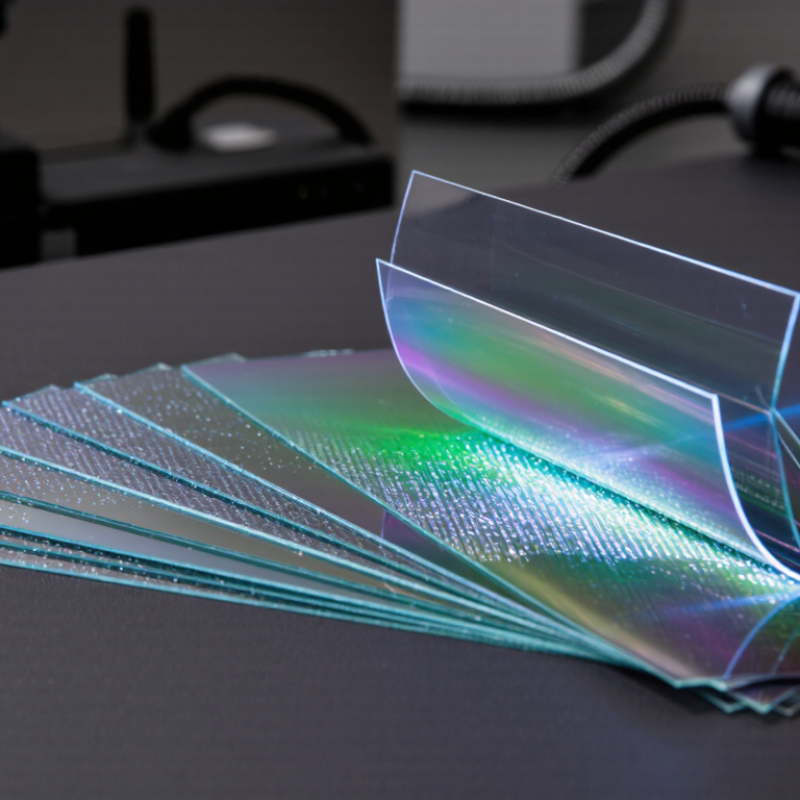
What Is Laser Film and How Does It Work?
Laser film is a specially engineered sheet that interacts with focused laser energy. Depending on its construction, it may record an image, create a visible mark, transmit light, or form a precise pattern. Its core characteristics include controlled thickness, dimensional stability, optical clarity, and resistance to localized heat. Many types also include a coated surface that reacts more readily than the base material.
The working process is precise but not mysterious. A laser moves across the film according to digital instructions. Where the beam meets the surface, energy is absorbed or reflected. Absorbed energy can darken a layer, remove a coating, or change the film’s appearance. The result depends on wavelength, power, speed, focus, and exposure time. In practical testing, even small setting changes can affect sharpness. Results may vary. That detail is easy to underestimate.
Tips: Check the film’s intended laser type before use. Keep the surface clean and flat. Test a small area first, using the same speed and power planned for production. Look closely at fine lines and edges. If they appear blurred, reduce heat or adjust focus. Film thickness also matters, especially when alignment is important. A reliable workflow records each setting, material batch, and environmental condition. This may feel excessive, but it helps explain inconsistent results. Temperature and humidity can influence handling, adhesion, and dimensional accuracy.
| Data Dimension | Core Information | How It Works or Why It Matters | Typical Considerations |
|---|---|---|---|
| Definition | Laser film is a thin functional film designed to interact with laser light, either by transmitting, reflecting, filtering, converting, or responding to the beam. | Its optical layer or surface structure changes how laser energy travels through or interacts with the film. | The exact meaning depends on the product type, such as optical film, laser-markable film, holographic film, or protective film. |
| Basic Structure | A typical construction may include a polymer substrate, optical or active coating, adhesive layer, and protective liner or hard coat. | Each layer contributes to flexibility, optical performance, surface protection, bonding, or laser response. | Layer selection must match the laser wavelength, power level, operating temperature, and intended surface. |
| Common Substrate Materials | Polyester (PET), polycarbonate (PC), polyethylene (PE), polypropylene (PP), and polyimide are frequently used film substrates. | The substrate provides mechanical support and influences clarity, dimensional stability, heat resistance, and flexibility. | Polyimide generally offers higher temperature resistance, while PET is widely used for dimensional stability and optical clarity. |
| Laser Wavelength | Performance is wavelength-dependent. Common industrial laser regions include ultraviolet near 355 nm, visible light around 532 nm, and infrared near 1,064 nm. | Absorption, transmission, and reflection vary with wavelength, so the film must be selected for the specific laser source. | A film optimized for one wavelength may absorb too much or too little energy at another wavelength. |
| Optical Interaction | The film may transmit, absorb, reflect, scatter, diffract, or convert incident laser energy. | Coatings, pigments, dyes, nanoparticles, or microstructured surfaces control the interaction with the beam. | Excessive absorption can cause discoloration, deformation, melting, or thermal damage. |
| Laser Marking Mechanism | In laser-markable films, focused laser energy creates a visible contrast through color change, carbonization, foaming, ablation, or removal of a surface layer. | The laser selectively modifies the film according to programmed position, pulse energy, speed, and focus. | Results depend on power density, pulse duration, scan speed, focus, and the film's absorption characteristics. |
| Thickness Range | Flexible films commonly range from several micrometres to a few hundred micrometres, depending on construction and use. | Thickness affects handling, flexibility, heat dissipation, optical path length, and resistance to tearing. | Exact thickness should be specified with tolerance because small variations can affect optical and processing consistency. |
| Key Optical Properties | Important properties include transmittance, reflectance, haze, refractive index, optical density, and polarization response. | These values determine how much laser energy passes through, returns from, or is dispersed by the film. | Testing should be performed at the intended wavelength and angle of incidence. |
| Thermal Performance | Thermal behavior is influenced by melting point, glass-transition temperature, heat-shrinkage rate, and thermal conductivity. | Laser energy can produce localized heating, so the film must tolerate the process without unwanted warping or degradation. | Cooling time, pulse control, ventilation, and substrate compatibility may be necessary for stable processing. |
| Surface Characteristics | Surfaces may be glossy, matte, transparent, colored, textured, coated, or hard-coated. | Surface texture and coating affect beam reflection, focus stability, mark contrast, scratch resistance, and cleanability. | Contamination, fingerprints, and uneven surfaces can reduce marking quality or optical uniformity. |
| Typical Applications | Applications include optical filtering, beam protection, security graphics, product identification, decorative effects, sensors, and flexible electronic components. | The film provides a lightweight, conformable alternative to rigid optical or marking components in selected designs. | Application suitability depends on required durability, optical precision, environmental exposure, and regulatory conditions. |
| Main Advantages | Laser films can be lightweight, flexible, fast to process, customizable, and suitable for high-resolution patterns or markings. | Digital laser processing can reduce the need for physical dies, screens, inks, or mechanical contact. | Benefits vary by film design and may require careful process calibration. |
| Main Limitations | Potential limitations include heat sensitivity, limited wavelength compatibility, surface damage, edge deformation, and variable contrast. | The laser-film combination must be optimized to balance processing speed, mark quality, and material protection. | Small-scale trials are recommended before full production. |
| Safety Requirements | Laser processing requires wavelength-appropriate eye protection, beam enclosure or controlled access, ventilation, and material-specific hazard assessment. | Direct or reflected laser radiation can injure eyes and skin, while heated films may release fumes or particles. | Use documented laser-safety procedures and verify the film's safety data before processing. |